[ad_1]

Gaming
,
Social Science
Starfield is an exciting video game. The anticipatory din around the release of Bethesda Game Studiosâ latest role-playing game exceeded anything I can remember in recent years, and was akin to the launches of the mega-games of yesteryear – titans like Halo 3, Grand Theft Auto V, and dare I say it, Skyrim.
But there was something different here. Something that suggested that Starfield might have deeper themes than any of those games and become truly special.
The great unknown
It started a couple of weeks before release when I read in a GQ article that Bethesda design director Emil Pagliarulo was moved âfrom atheist to agnostic and back againâ a reported five times during development as he explored the gameâs themes. It was something he elaborated on in an interview with Polygon a few days later:
âWe really want to dig into the sort of⦠high-level stuff with exploring space, the more theological aspects of it⦠We talked a lot about religion, and we ended up making up two religions for the gameâ¦
âThereâs the Sanctum Universum, and theyâre sort of the church where they believe that humans going through space and being able to explore the universe is a sign that God exists, and God wants us to be closer to Him.
âAnd then thereâs the Enlightened, basically an atheist church. Theyâre humanists; theyâre just like, thereâs nothing theological about this. And so we would have a lot of talks on our own journeys, our own theology. You know, what is out there?â
Would Starfield really get so philosophical? Would the developer that brought us memes like âstop right there, criminal scumâ and âarrow in the kneeâ be the same one to transform my thoughts on God? I was certainly excited to find out.
Games have a mixed history when it comes to heavy subjects. Approaches range all the way from The Outer Worldsâ âcapitalism badâ bombardment to more nuanced and ambiguous takes like that of BioShock Infinite – nuance that was unfortunately retconned out with additional narrative content in Burial at Sea.
Religion in particular is given unfair treatment in a lot of media, with believers often represented as hypocritical evangelists, set on converting or eliminating anyone with a differing viewpoint. Atheists are usually portrayed as more intelligent, scoffing at the stupidity of it all. The creatorsâ feelings are clear, and little is left to the player.
I hoped I could trust Bethesda to take a more even-handed and nuanced approach with Starfield, and the interviews seemed to support that. So, as a believer in Christian values who has always struggled with the concept of God, I booted the game up on 6th September and set off on a journey to find Him.
Warning: This article contains huge spoilers for Starfield‘s main quest from this point. I’d very much recommend completing the game yourself before reading on.
A divine revelation
My vessel for this journey of discovery is Captain Christian Jesus. Raised as a staunch Sanctum Universum believer, Jesus is suddenly thrust into a life of adventure after uncovering a mysterious artefact at the mine where he works. Overnight, he joins the explorer group Constellation and is tasked with finding more artefacts and uncovering more information about their origins and nature.
The overly charming Barrett, who is the Constellation member who volunteers us for the role, is quick to touch on the deep stuff, dropping into casual conversation that âthe infinite possibilities of the universe are full of everything but coincidencesâ.
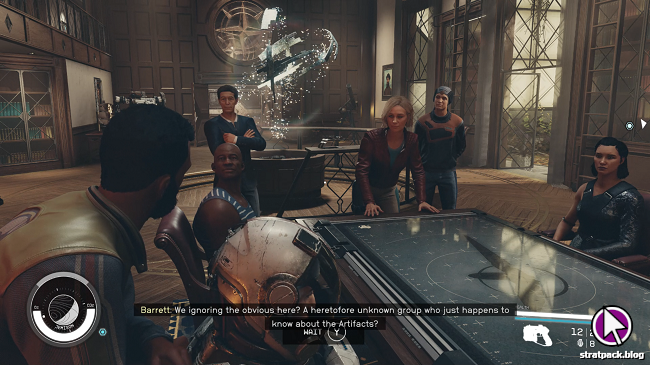
His views are shared by fellow explorer Matteo, who remarks that the artefacts must have been built by intelligence beyond the Settled Systems, and as a theological scholar seems keen to call the vision Jesus had when he touched the artefact a âdivine revelationâ. Incidentally, another character to have touched the artefacts will later say the experience was âlike drowning in your own soulâ.
Another Constellation member, Noel, is less convinced. A purely rational woman, she suspects that what happened to Jesus was a simple hallucination that can be explained by biological science. âScience brought us to space, not daydreaming,â she later says to Matteo. âWhatâs the point of science, if not to enable humanityâs dreams?â he retorts. âAnd where do those dreams come from?â
Constellation, and especially Matteo, have a socially awkward atmosphere thatâs reminiscent of your local school chess club. Itâs sometimes like they donât know how to talk to each other, and although they address the big questions as directly as anybody else in Starfield, they never explore them. Somebody randomly states a belief, someone else pipes up with an opposing viewpoint, and thatâs it. Nobody backs up their arguments or gets into the nitty gritty of their theological beliefs.
Some friendly competition
Eventually, Constellation finds the artefacts are tied to temples that grant Jesus special powers. But things take a turn soon after, when they encounter a group calling themselves the Starborn, who say they are ânot worthyâ of the artefacts.
âAbandon your thirst for knowledge, or drown in it,â they say, warning us to give up our search for the remaining artefacts. âThe more you understand, the more damage you will do.â Back at the Lodge, Matteo likens this to religious tales of angels preventing humans from uncovering forbidden knowledge that would harm them.
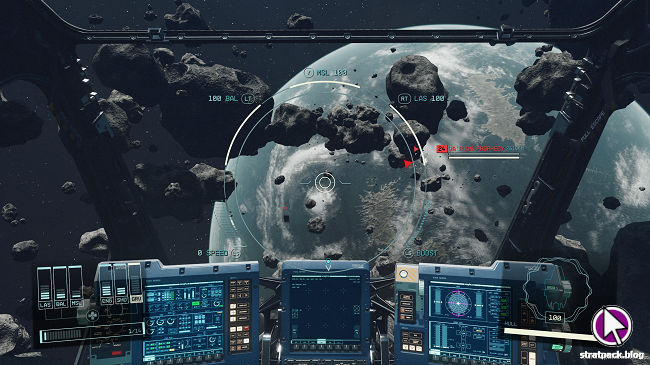
Constellation is rocked by an attack, as a Starborn calling himself the Hunter targets first their space station and then their headquarters, the Lodge. As we escape New Atlantis and head towards the station, we have a brief exchange over the shipâs communication system, in which the Hunter refers to a âgreater purposeâ and decides to let us go for now. âMaybe youâll glimpse the Unity yet,â he muses.
Naturally, talk at Constellation turns to what this âUnityâ could be. Matteo has heard the term used by Keeper Aquilus, the leader of Jesusâs religion, the Sanctum Universum. When we speak to him, he tells the story of a pilgrim who claimed to have seen the Unity, but until now he always thought it was a metaphor.
Different religions have different versions of this story, and it turns out that they all have unique details that we can piece together to point us to the pilgrimâs grave. This struck me as a nod to omnism or syncretism, with acknowledgement that various religions all hold parts of a greater truth that supersedes them all.
Sanctum Universum teachings
This seems as good a time as any for a detour and a closer look at the Sanctum Universum. What are the beliefs of Keeper Aquilus and his followers, exactly? Unfortunately thereâs not an awful lot that can be learnt via dialogue, but there are books sitting around Aquilusâs office that provide some additional insight.
The Sanctum Universum leader believes that humans exist to seek knowledge. Our consciousness makes us unique compared to other creatures, and the reason we are capable of learning is to find truth that brings us closer to the divine. He explains that much of our knowledge requires faith â even, for example, the existence of atoms, which we cannot see. We must believe in what somebody else tells us.
The Keeperâs books cover approaches others take to knowledge. Those like Noel, who follow science, put empirical evidence before all else, but Aquilas points out that our senses can be easily deceived. Likewise, rationalists who base all their knowledge on reason risk skewed results if their minds are warped by ideology.
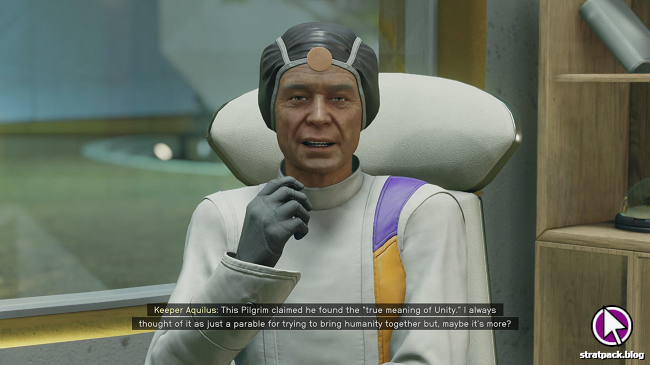
If you were to ask âwhyâ repeatedly, questioning everything in your search for knowledge, Aquilus asserts that you would eventually reach questions that science cannot answer: Why does causality exist, for example? Why does anything exist? The Keeper writes that the ultimate âwhyâ, or truth, is commonly attributed to God, often with an assumption that he is a good and caring entity.
But he says this traditional view of God is too narrow to describe the Unity, which is responsible for all other beings in the universe. There is no intention on its part here â the Unity to humanity is like soil to a plant â and we will all eventually return to it.
Aquilusâs religious texts even make a thinly veiled reference to Starborn like himself, as they state that âthose born of the starsâ are our guides in knowledge of the Unity and the pursuit of a more meaningful existence than we are capable of alone.
Seeking Enlightenment
Of the opposite viewpoint are the Enlightened â the âatheist humanistsâ mentioned by Pagliarulo. Based in the poorer part of New Atlantis known as the Well, local representative Andy Singh explains that they started as an intellectual movement built around atheism, but morphed into something more practical when they realised their goal should be to act on their empathy and help their fellow humans.
I could only find a single quest at the House of Enlightenment, which tasked Jesus with helping a patient get home after an operation, but there are books on a shelf in their headquarters titled Charity in a Godless Universe that provide a little more background to the organisation, its philosophy, and its differences with the church.
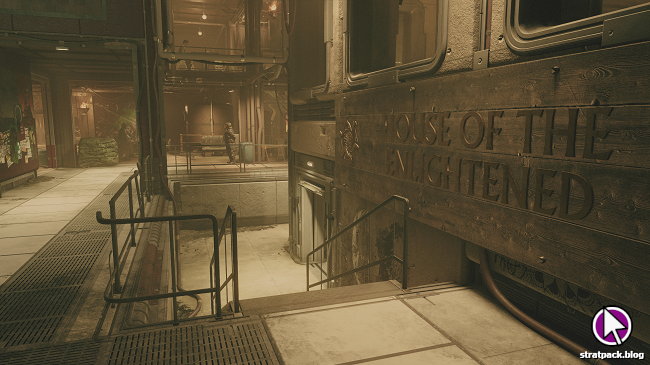
These books, written by Amelia Sang, document her problems with religion â namely that it offers too many contradictions and open questions, and that prayers are of no practical benefit. The church abandoned those in need at the settlement where she grew up, taking their donated credits and all but one of their power generators.
It was the Enlightened who fed people, helped them, and taught them the skills needed to sustain themselves. This more pragmatic approach was enough to convince Sang to convert. âHumanityâs capacity for empathy⦠is our speciesâ best hope to survive among the stars,â she writes. âItâs up to mankind to watch over itself.â
This Enlightened lore is the closest Starfield comes to the âreligion bad, atheism goodâ trap that I mentioned earlier. I could be imagining it, but it feels like whichever writer put these books together was expressing their own beliefs in a much more authentic way than whoever wrote the Sanctum Universum material, but at least between the two a range of beliefs are covered in a fairly even-handed way.
Spiritual gatekeeping
As we leave Keeper Aquilas and the Sanctum Universumâs temple to head for the pilgrimâs grave, he quizzes us about what we think the Unity is. If this force is holy, then why do we not consider gravity holy? Itâs only a brief exchange as we make our way out the door, but it gives the player some interesting food for thought.
After interpreting clues from the pilgrim, Jesusâs quest leads him to an impromptu meeting with the Hunter and the Starborn Emissary, which sheds some light on the puzzle. The Unity, is seems, is a kind of gateway between multiple alternate universes. The artefacts weâre collecting create an entity called the Armillary, which provides us with access to the Unity, where Jesus can himself become Starborn.
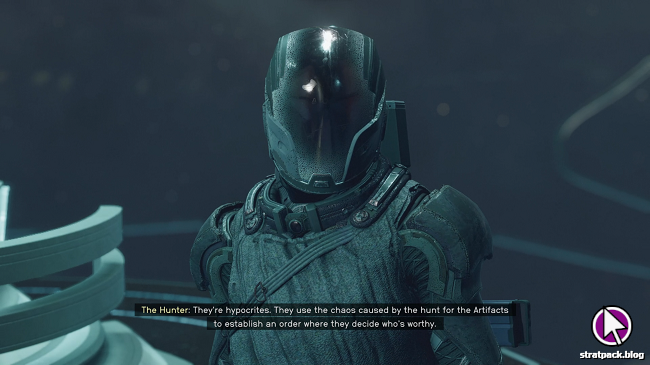
The Emissary wants to stop the Hunter from achieving this himself, as he believes nobody should have that much power. Meanwhile, the Hunter believes that the Emissary is just trying to control and conserve power for himself â âonly the worthy can reach heavenâ. I read this debate as potential commentary on organised religion juxtaposed with individual self-discovery, and the criticism that religious groups gatekeep spirituality in order to hoard wealth and power.
Weâre asked to side with one of the two, and after careful consideration, we choose the Emissary. Jesus is a religious man after all, and it seems more appropriate to place some restraints on access to the Unity based on a moral code than to allow one man to run riot â especially a man with such an evil-sounding voice.
Despite the vagueness over what the Unity is and what it means to be Starborn, the news causes much excitement at Constellation. Matteo ponders that witnessing it could potentially bring enlightenment or cast the seerâs mind into oblivion. Walter questions where his faith has disappeared to: âYou have an opportunity to reach the closest thing to your God that might exist, and youâre second-guessing it?â
Talking it out
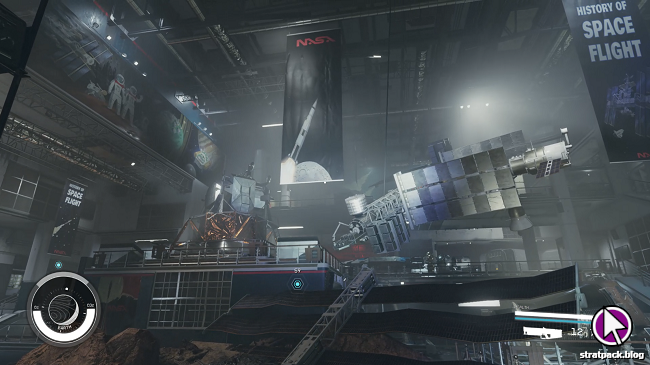
A trip to an old NASA launch site on Earth brings us back to the topic of forbidden knowledge. It turns out the catastrophic loss of atmosphere that mandated Earthâs evacuation was caused by experiments on an artefact discovered on Mars. This data led to the development of the grav drive technology that powers interstellar travel. Humanity is always pushing for greater understanding, but at what cost?
The main storyâs finale is, of course, a facedown with the Hunter over the final artefact. On the way, gravitational disturbances give us glimpses of alternate realities, and eventually this is what helps Jesus to convince the Hunter to hand over the artefact without a fight. Heâs been dissatisfied chasing the Unity in universe after universe, so we manage to persuade him that giving us an opportunity to succeed and become Starborn could also give him a happier outcome. To be honest, it really impressed me that talking out the final encounter was even possible mechanically.
Armillary complete, Jesus activates the grav drive and enters the Unity, where heâs faced with⦠something, perhaps even the Unity itself, taking the form of himself. The only explanation given for the temples and artefacts is that they were made by âthe Creatorsâ, who we cannot meet, at least for now. To become Starborn, weâre told that we must give up what makes us unique by walking through a portal.
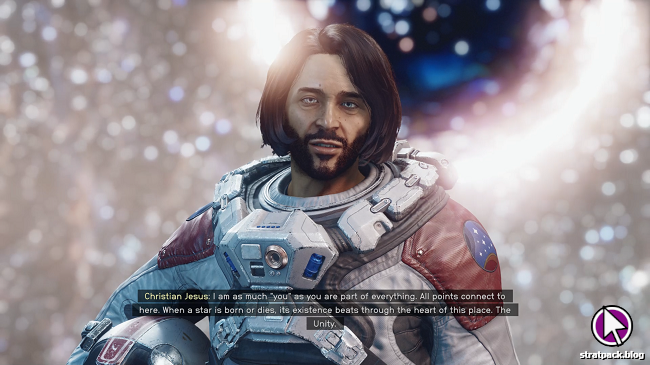
It all sounds very profound⦠until you realise that the entire plot of the game has been building up to an explanation of the mysterious and innovative New Game Plus that Bethesda touted through the pre-release marketing cycle. Becoming Starborn resets the game and gives you a fancy suit and ship, at the cost of losing all your items, credits, quest progress, and relationships with other characters.
Itâs a shame, because parts of the story really did hint that there was something there, some underlying philosophical statement that would tie together all the vague notions and mystery and say something. But while I was hoping for a theological equivalent to thematic depth exhibited by BioShock or Metal Gear Solid 2, sadly Jesusâs story ended with some new powers, but none of the answers he sought.
Uncovering the truth
Did Starfieldâs take on religion live up to the hype and give me a whole new outlook on the world and the wider universe? Not really. While the game did pose some interesting questions from time to time, it never really explored them beyond isolated statements, almost as though Bethesda thought players would get bored if they had to wait another couple of minutes before they could get back to shooting things.
An interesting detail about the timeline and setting is that Starfield is only set 300 years into the future, but space travel seems to have split humanity into more strange cliques than before â like social media on steroids. There are lots of mentions of God â or a God â but without any specifics, and as far as Iâve seen so far the gameâs religions only get as fleshed out as far as Iâve detailed in this article.
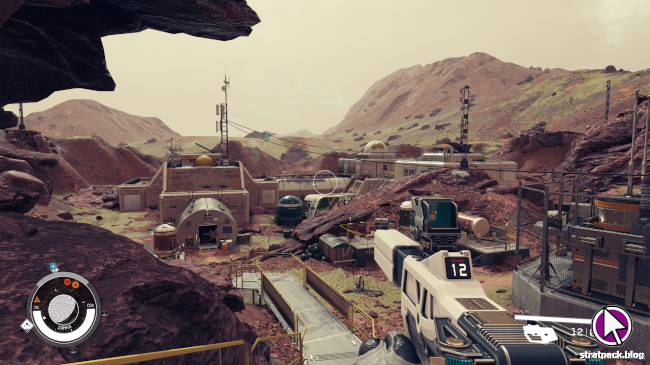
Itâs odd that a game whose main quest spends so much time in and around temples says so little about religion. If I were to guess as to why this is, Iâd suppose that Bethesda wanted to keep Starfield relatively light and fun â it is a mainstream AAA video game, after all. There was probably also a concern that adding any detail that sounded like criticism of real-life religions might offend somebody.
So do I think Emil Pagliarulo was lying in his interviews? Also no. I have no doubt that when the team at Bethesda was designing Starfield, doing all the necessary background reading and research, and writing its stories and characters, they fell down some theological rabbit holes and had some interesting discussions. But very little of this is presented to the player in the finished game, which instead opts for pseudo-profound soundbites without ever delving beyond the surface.
I wasnât expecting Starfield to be 2023âs answer to St Augustineâs Confessions, but I was hoping for something a little more intellectually stimulating, and at the very least for the game to posit a theory of its own in the form of an in-universe explanation of the Unity. Perhaps weâll find out more about the Creators and the other religions in a DLC, but until then youâll find me in the Sanctum Universum library.